I think in this text, details like the timeline are simplified a bit too much. But I agree with the general tendency described.
There was never a time where software was perfect, but the accelerating cadence of serious, widespread incidents with real-world effects seems real.
At one point around ten years ago, I was in a software development training course talking about test driven development. We did a roundtable exercise where each developer took turns writing tests and then someone else wrote code to try to get the test to pass.
One of the developers in the exercise wrote code that was obviously incorrect to pass one of the rounds, but all of the tests passed. After that code was written, everyone basically became stumped as to how to proceed, and we largely ended up talking about how the “coach” needed to “catch his flight” soon and he exited the exercise early.
I must admit I have not read 100% or even 50% of the vibe-coded crap I produce in my latest slopware, but I have a distinct feeling it fits in the category of the type of code written by this developer at the roundtable exercise. It’s not wrong in a quickly provable way, but it ain’t fucking right in a fundamental way.
When I was a hands-on developer (around 5 years ago+ at this point as I did a stint in management / design type roles), I used to build my way up to problems. My proposals and documents attempted to show what I was solving and what I was not, cleanly and clearly. You could read a document or code of mine and I would try to make it obvious what was missing. AI works the exact opposite way, it builds a mountain of bullshit that looks plausibly like it could be solving the whole problem, and it’s up to you to try to sift through that and figure out what is missing.
I’ve encountered innumerable issues in the software I slop together these days, and I have to say I think this thing does a good enough impression of working software that many people will not find these problems. There are a variety of different ways that things are incorrect when you interact with the software that if I did actually read the entirety of the codebases, I do not believe that the basic structure would even make sense.
Just for kicks, I read through parts of one of my larger slopjects tonight, and it looked like a mess of tiny functions with no coherent structure binding them, which pretty much confirms my suspicions.
I understand too that a lot of corporate software was like this anyway, so who knows, maybe we’re trading like for like or something. But there used to be at least one person who knew how shit worked. I’m not sure that person exists anymore.
When I was a hands-on developer […], I used to build my way up to problems. […] AI works the exact opposite way, it builds a mountain of bullshit that looks plausibly like it could be solving the whole problem, and it’s up to you to try to sift through that and figure out what is missing
I fucking hate doing the latter. If you do it right the first time, you’ll have a solid foundation and won’t have to live in a patchwork house.
I think metrics like code coverage are a big part of the problem where devs are encouraged to stop short of fully testing something or write low-quality tests that prove nothing to satisfy the metric.
The classic simple example is a divide function that takes a dividend and divisor and returns a quotient. One test that passes 6 and 3 and asserts 2 yields 100% code coverage, but what what about divide by zero errors? Does it work with negative numbers? Etc., etc. You’re definitely not done with tests, despite the metric saying you are, and a slop generator (human or AI) could certainly write a fundamentally broken implementation that passes the tests.
Now combine that with a tendency to focus on unit tests that test the system in a manner that hardly reflects how it works in production, and you have a system that passes all the tests, yet doesn’t actually work.
This is generally solvable via mutation testing. Sadly, almost no developer knows what mutation testing even is.
Yes! I’ve been trying to put my finger on what the problem with AI generated code is and it’s coherence!
@aesthelete @technology Insightful.
Llms are a way to manage the complexity that we really haven’t figured out how to use yet. There is a Cambrian explosion of ideas we need to figure out which one are good and move forward with those. We are using these tools to fix issues in firmwares for example that the company have long given up on. Nothing is off the table anymore with hardware and software and we need to learn how to adapt. Our governments will overreach to stop it, and others will use it in ways that cause governments to want to do that sadly.
MBAs and Covid hires are running software into the ground.
We built a whole KPI and promo system (and reinforcement loop) on “impact” and “velocity” and “commit counts” and layoff threats, and now we’re confused why software is going to shit.
We built an entire enshittification feedback loop. Of course it’s going to shit! I get paid for what I shop, not what outages I prevented. Oh, we built up blameless retros, but what’s the first thing everyone asks after an outage? At least now we can say Claude did it so we’re not in the hot seat when I stop reviewing PRs, right?
Jesus fuck.
ETA: this is a reinforcement loop to produce bad software, externalize as much as possible, and fuck over the user. No wonder everyone hates tech now.
My motto has always been “defund MBAs.”
Much like I think anyone with a political science degree probably shouldn’t be in politics, I find most MBAs have all been forced to learn the same type of management and it’s terrible.
I read one of my ex’s homework for their management short course. Not sure if it’s different from an MBA, but the course actually had really good advice for managing things properly. Stuff like, if you have highly skilled and intelligent workers, don’t micro manage them; trust them to do their job properly. Or, how to handle conflict professionally. I was really surprised actually
That sounds more like a team management course than business administration though
Watched a youtube with the kicker “The degree that destroyed reliability” or some such - MBAs, of course - that was mostly a documentary about Boeing and how changing from engineering CEOs to MBA CEOs literally killed people and nearly destroyed the company.
I think Wired did a lengthy report on it.
MBAs and Covid hires are running software into the ground.
Close. MBAs and Covid FIRES are running software into the ground.
https://brucefwebster.com/2008/04/11/the-wetware-crisis-the-dead-sea-effect/
Interesting, hadn’t seen that
I’ll add there’s a counterpoint to this: if you look at people with a tenure less than 1-2 years at like 4-6 different jobs then you should also be suspicious, because that’s just long enough that they never face consequences for the long term effects of their work.
As someone who has been laid off multiple times 1-2 years into a job, it’s not that I didn’t want to stay. It’s almost always been part of mass layoffs for financial reasons.
I only left any company voluntarily twice. Because the environment there frankly sucked or I wasn’t learning anything new or useful after ~1y
Buad is such a joke. Everything valuable is in the 1st year. Only someone without a single entrepreneurial bone in their body would finish a degree.
I remember working for a company in a tech incubator and realizing that literally the incubator’s entire staff were 22 year olds with zero real world experience.
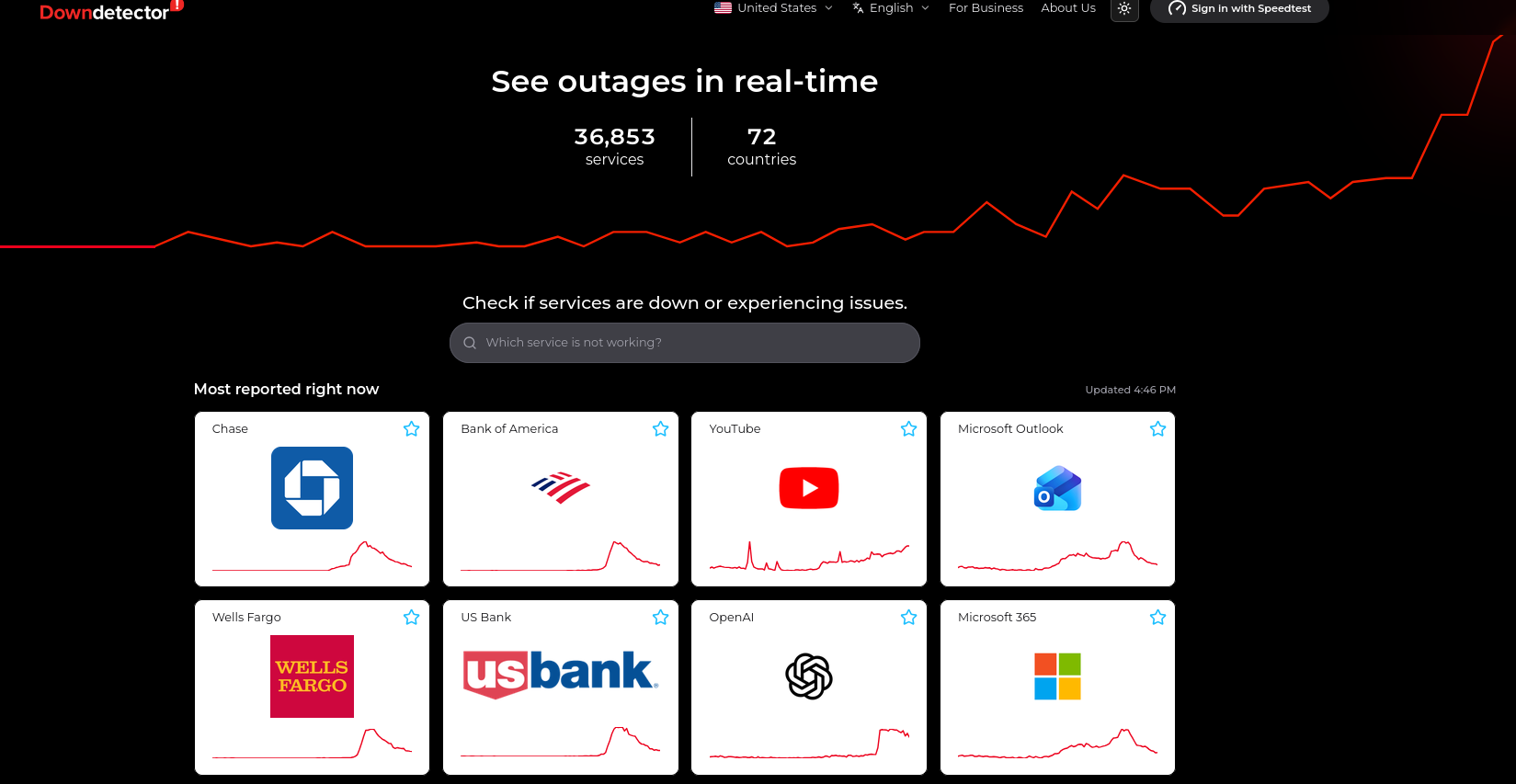
As of right now there is even more centralized things going down:
Poor article. Way too much doom and gloom.
“AI is both a cause and a symptom of the problem here”
Author starts but citing php2shell (caused by a bug written 10 years ago by a human), Emudhra (caused by human laziness and incompetence), FAA outage (broken physical wiring and poor human written contingencies)
None of those were caused by AI.
Vast majority of this years’ CVE floods have been /discovered/ by AI, not caused by it. These reports are already starting to level out, according to Linus. AI is finding them quickly, for good and bad, because we’re asking it to - but it’s not the cause. It will be a cause for future bugs caused by software being written /now/, because it’s writing more software now.
The actual reason we’re seeing more breakages than before is that we’re using technology more than ever in critical services without good contingency planning.
The author explicitly states that it’s not (solely or primarily) because of AI. Did you read it, or did you get an AI to summarise it for you?
I’m sorry, but we absolutely don’t know what caused the FAA outage. The fact that you believe the first official stories is WILD and I can’t trust anything else you push
None of those were caused by AI.
The author does not claim that.
He says that AI comes on top of these trends and that using AI in a way that creates more bugs is caused by common forces.
The actual reason we’re seeing more breakages than before is that we’re using technology more than ever in critical services without good contingency planning.
And why is that?
imo the article wasn’t really about AI, but rather obfuscation through endless, undecipherable chains of dependencies reliant on unpaid volunteers for both creation and maintenance.
The article mistakes improved discovery as an increased failure rate.
I was there when Windows blue screens where a completely normal thing. I used software from the 90s in the 90s. No, software isn’t getting worse overall.But naturally, software as a service adds the internet and someone else’s servers as a dependency. You get the convenience of someone else managing that service for you in return. And enshittification is real, too.
I was there when Windows blue screens where a completely normal thing.
I remember well. It was what brought me to using Linux.
But back then, it was not used for critical infrastructure, because it was simply not reliable enough. Nor for monitoring chlorine levels in swimming pools.
At least you didn’t need a 20MB executable and 700MB of RAM to perform simple tasks. Software is definitely getting worse in that respect
True, but at the time you would able to do only the simple tasks.
While it is true that software is becoming more bloated as the time pass I think that most of the people do not really remember what it was to use these software.
I consider this to be similar to industrialisation.
Like how people would make most stuff in house (eg: butter from milk) and now they order/buy premade because the milk is already treated and not suitable.
This needs a vast amount of industrial equipment to support, even something simple and the logistics allow a clean separation. This clean separation is missing in software where people end up consuming the industrial output but with the heavy machinery (RAM usage) still included
The browser is that clean separation: A unified set of capabilities offered to a server to run a reasonably low-latency GUI on while the data and actual application is on the server. You don’t have to administrate this forum. Someone else does that.
Another example is game streaming where the game runs on the server and your system only needs to be able to display the resulting rendered images fast enough. But you need really fast and stable internet connectivity for this. Wifi is too unreliable. And the network latency is killing this for fast-paced games.
There are good reasons for the mainframe and thin clients of the past going extinct. Running stuff locally comes with benefits.
Just wait till decoherence starts manifesting in other areas of society. It’s not only code that’s going to come unglued from the sum of its parts.
Cyberpunk rings truer every day. We could very well be heading into a world of literal societal decay. Complex systems crumbling because we let automation take the reigns. The experts holding it all together got made redundant. Nobody is there overseeing the big picture.
(reins)
This changed the balance of power between workers and management.
Imagine a building site where there is a plumber, a builder, and an electrician. If any one of them threatens to quit, you have a problem, because you need each of them to get the project done. Whereas if you can make everyone a mix of plumber-builder-electrician, they lose that leverage.
Whether you think that power imbalance is a bad thing may depend on your politics. But it had a slow effect of taking influence away from the people close to the work. They’re the ones able to raise the alarm when things start going wrong.
Another angle on how capitalism is making the world worse. Idiots and incompetents with money are calling the shots, and driving us all off a cliff.
Plus an ideology which views breakdown of infrastructures that are essential for societal well-being and safety as positive because it fosters goals of dominance and authoritarism. Think only in the crippling of the US CDC or the met service.
I suppose if everyone doesn’t know how to do stuff and keeps developing critical systems that rely on the same, flawed code snippets on git/ stack overflow/ etc, yould eventually have this problem. It’s come home to roost.
Build on sand, get a sand castle.
As a silver lining, I think there will be a reniassance in self hosting, local clouds, hacking and such.
Not on national scales. But bigger than it is now.
It’s already kinda happening in gaming, with AAAs decaying with alarming speed, indies doing well, and modding/reverse engineering absolutely taking off like a rocket. It may suck for the average gamer, but awesome software is there if one seeks it out. Or makes it themself.
Indie game devs have currently the problem that they need to figure out a way to market themselves without some vibe coder copyong their ideas or asking for ransom from indie devs before they copy the game. We as gamers also have a harder time to go find the games that are actually worth while (developed with AI or not).
Either way, I hope indie devs will find a way forward.
This guy is delightfully close to a cause, but not really.
In the enterprise space, we largely avoid NPM or Composer, et al, because those very best-practice docs (iso27002, here, later SLSA) prohibit repos that obscure or frustrate validation and code pedigree; and the gleeful incestuous inclusion of projects within projects means source code isn’t properly managed - a failure - so npm won’t do. SBoM and validation is key.
So that covers half his premise; and while some shops or people use and love npm and cpan et al, the kind of people maintaining banking or travel systems should most absofuckinglutely NOT be using those ecosystems lest they lose their certification the first time a clued audit comes through. You wouldn’t accept code violations from your architect or your builders, and programmers are the same way in that space.
The problem, it seems, is sloppy people doing sloppy things and not getting caught.
I’m sure Ai is a big help with this, but it’s only enabled by the same sloppiness that was already present.
Great news: civil courtrooms try negligence and code-violation cases all the time.
In the enterprise space, we largely avoid NPM or Composer, et al, because those very best-practice docs (iso27002, here, later SLSA) prohibit repos that obscure or frustrate validation and code pedigree; and the gleeful incestuous inclusion of projects within projects means source code isn’t properly managed - a failure - so npm won’t do.
Rust (that is, cargo and crates.io) does in principle the same, and Java (via Maven) as well. Their quality is arguably better, but a lot of modern software has hundreds of dependencies.
I am wondering whether the SBOM philosophy is merely a box-ticking exercise. It does not buy you much when you know you have a buggy 15 years old TCP stack in your industrial control, but you can’t upgrade it because there is no storage left on your device. And the same holds for Cisco routers. Constantly upgrading works,in my experience, only with completely open systems like Linux, on open hardware.
but a lot of modern software has hundreds of dependencies.
Which by the way also leads to an interesting state of matter once you reach the point where every dependency problem you fix causes on average more than one new problem elsewhere. The reason is that if dependencies are not strictly backwards-compatible, that’s a breaking change – and with large depedency graphs, breaking changes tend to cause more breaking changes. You get kind of a nuclear chain reaction.
Which is the reason you lock down the dependencies and maybe you build a in-house server to host them (be NPM, composer of whatever) so everyone fetch a certified version and it is the same for everyone on every project, with an upgrade that need to follow a strict process.
SBoM and validation is key.
Yes, unfortunately the SBoM too often is a Yaml file that gets changed every time someone wants to use a new Ruby gem. https://openssf.org/projects/slsa/ is a page with a small blurb and an embedded video! slsa.dev looks interesting and I’ll check into it later.
Management everywhere cares about velocity more than they care about anything else. They’ll always find workarounds for anything requiring careful thought.
Yup, we’re all right royally fucked in the least loving way imaginable. Most people just don’t know it yet.
But they will.