Aptera Completes Its First Solar Electric Vehicle for Customer Delivery Carlsbad, CA — November 19, 2026 — Aptera Motors Corp. (Nasdaq: SEV), a solar mobility
The flaw is the amount of energy collection from the solar panels on a car sized object will always be significantly lower than the energy needed for street legal weight making it a novelty. It can’t really scale up to a useful vehicle that primarily relies on solar panels.
This would also be true if the solar panels were 100% efficient, which makes it a flawed design.
I feel like so many comments are defending a pointless gimmick by assuming it would work as well as the marketing that is obviously a load of bullshit and that it can’t possibly have any downsides.
It’s the most aerodynamic of all cars, and it has 2 charging options: electrical outlet and solar. But there you go off on a rant about some other problem you’re making up.
I’m referring to the existence of things like signals, airbags, and other safety features ends up being required weight to be street legal. Not a set ‘street legal’ weight, just weight required to meet legal requirements.
On an ultralight vehicle that could take up a significant proportion of the weight.
Does weight really matter that much at speed? At least for biking, I got the impression that it was aerodynamics that dominate resistance after like 20mph. Weight should mostly just affect acceleration speeds, not energy (although if you end up going slower on average you’d have less air drag, so more weight I guess could incidentally save you energy in some cases?)
As you noted, stopping and starting are a huge portion of energy expenditure for vehicles, not consistent speeds. That’s where weight has the biggest impact.
Driving a limited range vehicle is likely to have a lot more stops and starts.
Why would it have more stops/starts taking the same route? Also, that only requires more energy if you break (in which case, you’d lose about 70% of that energy that you forcibly convert to heat and asthma). If you just stop pushing the accelerator when you need to stop, you can save like 75% of the energy loss compared to average drivers. Its wild watching people drive cars so inefficiently.
Edit my car has progressive steps for regenerative from the accelerator pedal and breaks regeneratively when that pedal is pushed as well, I didn’t think about the first thing earlier.
Gotcha, so you know that the primary mode of charging is the NACS port under the license plate cover, and the solar is supplemental to add to driving range, around 40 miles per day in optimal conditions?
Yes, I completely understand that this is a battery powered vehicle marketed as a ‘solar vehicle’ that gets a potential 10% increase in its projected 400 mile battery range as long as it in optimal sunlight for the entire day. That is a flawed design because it will never get the optimal 40 miles in the real world AND it would only get that potential extra power over the course of an entire day as long as it was driven at least 40 miles because the power has to trickle into some kind of storage as it isn’t fast enough to have any impact while driving.
Their magic goal is one that can do up to 1,000 miles. The extra mileage from the solar panels isn’t proportional because it isn’t going to be proportionally larger, it becomes less and less of an impact as the charging distance increases. The solar panels are a useless gimmick.
Leaving this kind of vehicle out in the sun to get that likely over estimated amount of charging means more sun damage and weathering, which isn’t great for vehicles. Especially for an over engineered design like this one with the wheels outside the main body.
So instead of features being built into cars that reduce my expenditure incrementally, I’m supposed to… Checks notes pay for every single kilowatt hour plugged in somewhere?
Just separate the solar panel from the car itself. Putting them together makes way too many engineering compromises.
Grab yourself a modular home solar generator system (solar panel, batteries, inverter) with maybe 2 kW worth of panels and 10 kWh of backup battery power, and you can outperform this arrangement by keeping the solar panels in the sun at all times.
Yup! The solar panel can be placed in a way to get better sun coverage because it doesn’t require the vehicle to be parked in a specific direction and the vehicle can be covered from the weather while it is charging!
I cannot imagine the additional cost of incorporating a solar panel on a vehicle is lower than the cost of the power it would potentially save over a couple decades. Having to leave it out in the sun all the time just to get the benefit is going to significantly shorten the life of vehicle parts.
Not to mention the solar panels themselves will degrade over time so even the 40 mile best case scenario will drop off over time.
It is a great design in imagination land where nothing wears out and we always get the optimal outcomes. If only we lived in that world it would be a great design!
First of all, have you seen parking lots? Cars get left in the sun all the damn time.
So let’s say over the life of the vehicle, it’s only 25% the distance it says. So that’s 10 miles, maybe 2kwh of charge per day, average.
That’s 6000 kilowatt hours, current power rates probably 600$ to charge.
But this is a California company. They have over half the year clear days. Even if you don’t park in full sun every time, the average will be much much higher. The drop in efficiency of the panels would be %10 over 10 years. It’s maybe impossible to drop that lifetime efficiency below like 60%, even that low is a stretch.
On a chassis that already has a battery and battery management system, a flat ish roof, it’s dumb to not take a built in panel option as a convenience, even if it’s break even in terms of cost.
Summer is road trip, camp time, and an extra 20 miles a day minimum off grid is actually really compelling. I could drive 400 miles out to the middle of nowhere, leave my car parked for a week and it would have half a charge back for the drive home.
Your arguments read like “I want perfect performance for the entire length of ownership PERIOD.” Which doesn’t happen with any product. If it’s not good for you, because you own underground parking or whatever and you can’t imagine how other people live great, it’s not a good product for you. Other people will actually find it useful.
the power has to trickle into some kind of storage
Are you sure you “understand solar power”?
No one is saying that this is a “solar powered vehicle” in the sense that it can be powered exclusively by solar power. It just has some panels to collect energy that would otherwise be wasted. They are not a useless gimmick, they are a marginally useful gimmick, the company knows this, and buyers also know this.
Forget the marketing. If it gets half as much range, that’s still enough to cover 90% of most people’s driving needs, and the rest can be supplemented by wildly cheap electricity. Or maybe plugged into a few panels on the ground.
The point of the vehicle is ultimately reduced consumption.
I agree the solar panels are partially a gimmick but they are a really cool one.


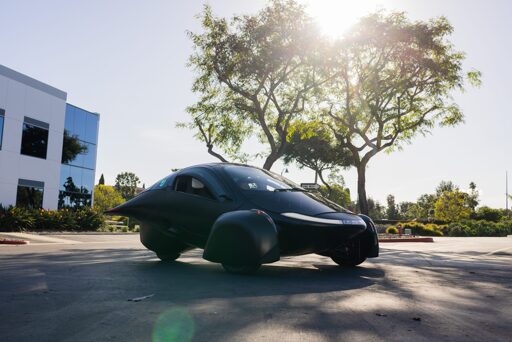
The flaw is the amount of energy collection from the solar panels on a car sized object will always be significantly lower than the energy needed for street legal weight making it a novelty. It can’t really scale up to a useful vehicle that primarily relies on solar panels.
This would also be true if the solar panels were 100% efficient, which makes it a flawed design.
i feel like so many comments are from folks that think this vehicle is meant to only run on solar power.
I feel like so many comments are defending a pointless gimmick by assuming it would work as well as the marketing that is obviously a load of bullshit and that it can’t possibly have any downsides.
theydidntdothemath
It’s the most aerodynamic of all cars, and it has 2 charging options: electrical outlet and solar. But there you go off on a rant about some other problem you’re making up.
What is this?
I’m referring to the existence of things like signals, airbags, and other safety features ends up being required weight to be street legal. Not a set ‘street legal’ weight, just weight required to meet legal requirements.
On an ultralight vehicle that could take up a significant proportion of the weight.
It’s street legal as a motorcycle classification. Might still have airbags, but crash safety standards are not the same.
Does weight really matter that much at speed? At least for biking, I got the impression that it was aerodynamics that dominate resistance after like 20mph. Weight should mostly just affect acceleration speeds, not energy (although if you end up going slower on average you’d have less air drag, so more weight I guess could incidentally save you energy in some cases?)
As you noted, stopping and starting are a huge portion of energy expenditure for vehicles, not consistent speeds. That’s where weight has the biggest impact.
Driving a limited range vehicle is likely to have a lot more stops and starts.
Why would it have more stops/starts taking the same route? Also, that only requires more energy if you break (in which case, you’d lose about 70% of that energy that you forcibly convert to heat and asthma). If you just stop pushing the accelerator when you need to stop, you can save like 75% of the energy loss compared to average drivers. Its wild watching people drive cars so inefficiently.
If it’s outfitted right, the thing would have regenerative braking.
I think that only recovers about 30% usually? That’s why I mentioned the 70% is lost. For ICE cars, it’s 100%.
Ding ding yes
Edit my car has progressive steps for regenerative from the accelerator pedal and breaks regeneratively when that pedal is pushed as well, I didn’t think about the first thing earlier.
Smells like a load of bullshit.
Definitely read about it before you come to an opinion on it.
I did…
I also understand the basics of solar power and how much energy it takes to move objects.
Gotcha, so you know that the primary mode of charging is the NACS port under the license plate cover, and the solar is supplemental to add to driving range, around 40 miles per day in optimal conditions?
Yes, I completely understand that this is a battery powered vehicle marketed as a ‘solar vehicle’ that gets a potential 10% increase in its projected 400 mile battery range as long as it in optimal sunlight for the entire day. That is a flawed design because it will never get the optimal 40 miles in the real world AND it would only get that potential extra power over the course of an entire day as long as it was driven at least 40 miles because the power has to trickle into some kind of storage as it isn’t fast enough to have any impact while driving.
Their magic goal is one that can do up to 1,000 miles. The extra mileage from the solar panels isn’t proportional because it isn’t going to be proportionally larger, it becomes less and less of an impact as the charging distance increases. The solar panels are a useless gimmick.
Leaving this kind of vehicle out in the sun to get that likely over estimated amount of charging means more sun damage and weathering, which isn’t great for vehicles. Especially for an over engineered design like this one with the wheels outside the main body.
The design is bad and they should feel bad.
So instead of features being built into cars that reduce my expenditure incrementally, I’m supposed to… Checks notes pay for every single kilowatt hour plugged in somewhere?
Just separate the solar panel from the car itself. Putting them together makes way too many engineering compromises.
Grab yourself a modular home solar generator system (solar panel, batteries, inverter) with maybe 2 kW worth of panels and 10 kWh of backup battery power, and you can outperform this arrangement by keeping the solar panels in the sun at all times.
Yup! The solar panel can be placed in a way to get better sun coverage because it doesn’t require the vehicle to be parked in a specific direction and the vehicle can be covered from the weather while it is charging!
Why??
My car sits in the sun! It has a battery bank!!
I don’t want to think about it!
I don’t want to put up and take down things!
My time is worth more than that. If yours is not, go do what you said with a different car.
I cannot imagine the additional cost of incorporating a solar panel on a vehicle is lower than the cost of the power it would potentially save over a couple decades. Having to leave it out in the sun all the time just to get the benefit is going to significantly shorten the life of vehicle parts.
Not to mention the solar panels themselves will degrade over time so even the 40 mile best case scenario will drop off over time.
It is a great design in imagination land where nothing wears out and we always get the optimal outcomes. If only we lived in that world it would be a great design!
First of all, have you seen parking lots? Cars get left in the sun all the damn time.
So let’s say over the life of the vehicle, it’s only 25% the distance it says. So that’s 10 miles, maybe 2kwh of charge per day, average.
That’s 6000 kilowatt hours, current power rates probably 600$ to charge.
But this is a California company. They have over half the year clear days. Even if you don’t park in full sun every time, the average will be much much higher. The drop in efficiency of the panels would be %10 over 10 years. It’s maybe impossible to drop that lifetime efficiency below like 60%, even that low is a stretch.
On a chassis that already has a battery and battery management system, a flat ish roof, it’s dumb to not take a built in panel option as a convenience, even if it’s break even in terms of cost.
Summer is road trip, camp time, and an extra 20 miles a day minimum off grid is actually really compelling. I could drive 400 miles out to the middle of nowhere, leave my car parked for a week and it would have half a charge back for the drive home.
Your arguments read like “I want perfect performance for the entire length of ownership PERIOD.” Which doesn’t happen with any product. If it’s not good for you, because you own underground parking or whatever and you can’t imagine how other people live great, it’s not a good product for you. Other people will actually find it useful.
Are you sure you “understand solar power”?
No one is saying that this is a “solar powered vehicle” in the sense that it can be powered exclusively by solar power. It just has some panels to collect energy that would otherwise be wasted. They are not a useless gimmick, they are a marginally useful gimmick, the company knows this, and buyers also know this.
It is being marketed as a solar electric vehicle.
If it isn’t designed to be what it is called that also makes it a flawed design because it isn’t what they are calling it.
Forget the marketing. If it gets half as much range, that’s still enough to cover 90% of most people’s driving needs, and the rest can be supplemented by wildly cheap electricity. Or maybe plugged into a few panels on the ground.
The point of the vehicle is ultimately reduced consumption.
I agree the solar panels are partially a gimmick but they are a really cool one.
They are a shitty gimmick.
Well, agree to disagree.