
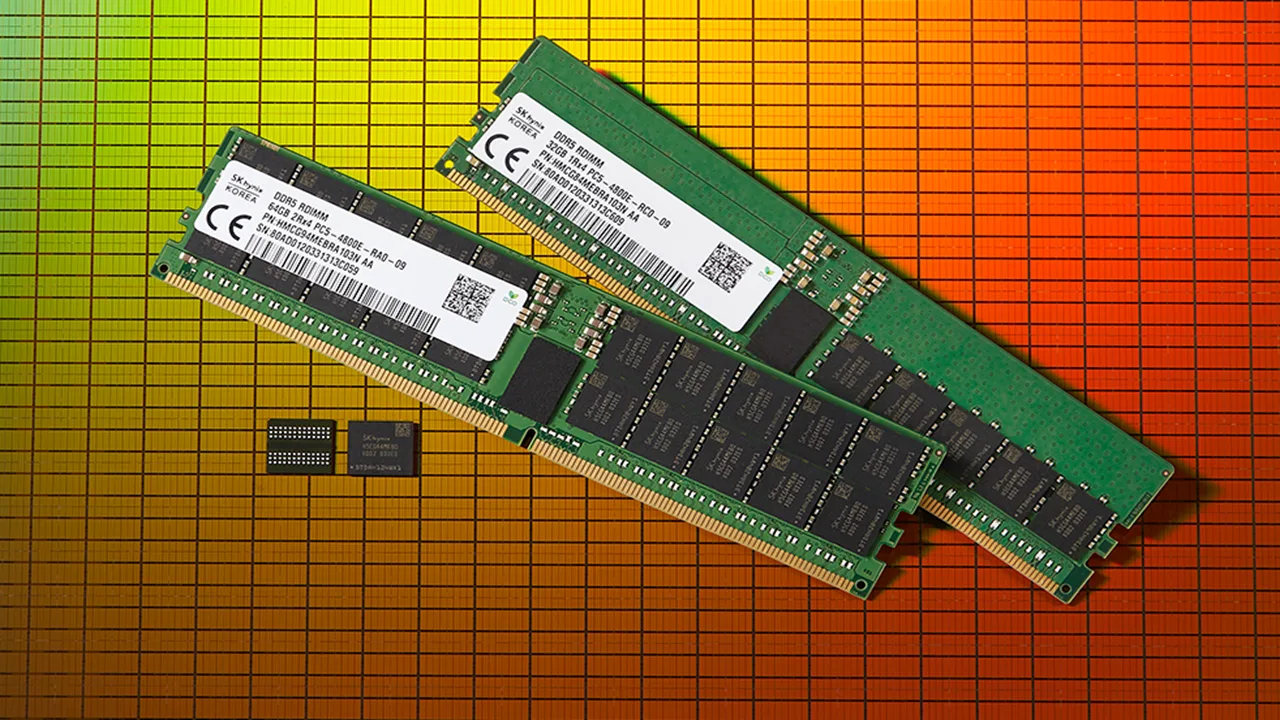
Most of 2026 went by with inflated prices for DDR5 memory, SSDs, and GPUs but next year may finally bring relief from gamers and tech companies producing consumer electronics, at least according to one market analysis report on SK Hynix coming out of Seoul, Korea. BNK Investment & Securities analyst Lee Min-hee shares a detailed […]
Please YES.
Also with GPUs and CPUs and motherboards and disks…
especially ssds/hdds…
My drives keep failing and I’m too stingy to buy a new one at these prices…
I dont think They want those to ever go down because then you can own your data. Ram, eh they dont care. But why would they let peasants own data when they could make billions renting it. My guess is drives will never again be affordable.
the current estimate for reasonable ssd prices is january, but take it with a grain of salt. we’ll know more once the stock market does its thing next week.
The last article I saw (a few days ago) predicted SSD prices would start to drop towards the end of 2027. So I take all these articles with a pinch of salt.
Yeaaaa, I’m running low on space and I have to be constantly doing tricks to be able to make up some more space. I hate this.
I’m not out of space (had the good sense to buy several 1 TB SSDs back when they were cheaper), but I’ve taken to prioritizing playing games by size on disk, just because modern games are getting enormous (WTF, GoW: Ragnarok @ 175 GB, and I hear GTA 6 is over 200 GB).
It’s especially important on my Steam Deck, since I keep a lot of games on it and can’t expand it to more disks, only bigger if I wanted to.
I will say, I’m looking forward to being able to expand my NAS. I spent around $600 for four 2 TB disks for it, which nets me around 5 TB with RAID5. Just to replace the same disks now would run me around $2000, and to upgrade to 4 TB SSDs of the same would be closer to $5k. I’m seeing some SSD prices dropping, but they’re cheaper QLC disks.
Yeah.
I also somewhat hope that some new gen of drives that have the best of HDD (higher life expectancy) and SSD/M.2 (higher speeds), with added higher data/info density per physical block, so we can have more storage in less space with the same or lower price. I know it won’t happen in the short to medium term, but dreaming is free hahahahah.
Anyway, even so, there is some interesting progress in that direction, so who knows.
I will be buying a lot of cheap spinners and sticking an ssd in front as a hobo cache.
I tried spinning rust but the NAS lives in my living room and I’m in the rurals with a low noise floor, the constant clicking and whirring was driving me nuts.
I’m sold on the silence of SSD, even if it costs more.
I put a cheap old mini PC in the living room as a headless media machine, but the NAS is in the closet. Those repurposed enterprise drives are loud.
Had to run MOCA through some old coax in the wall to the entertainment center, but it keeps the clicking down.
My next NAS will likely just be a PC with UnRAID or TrueNAS.
I’ve been using QNAPs for a long time, but they’re just not impressive for their cost and I’d like something more easily expandable.
I’ve got a few cheap mini-PCs in the living room too, one running Proxmox with Home Assistant and an Ubuntu Linux media server, and another dedicated to Audiomuse-AI. Ryzen 5700u boxes, they’re low wattage and essentially silent from 3 feet away unless under really heavy load.
I also run proxmox, but never tried true nas. I don’t really have other users that need the GUI. Now that I’m used the CLI it’s just copy paste.
I thought about TrueNAS VM with HBA passthrough on one of the PVE nodes. Just never did it .
I went with Debian VM with ZFS + (plain smbd does fine too) on my main PVE host, and bare metal Debian on my headless backup NAS.
(I have a collection of cast off DDR4 era enterprise minis, they pull at most 45w each, but usually the whole stack (switches and all) barely goes over 80w. The full tower backup nas (old ddr3 era gaming PC with no GPU), pulls more, but only runs a few hours a week at most.)
I like hearing them run 🫠